
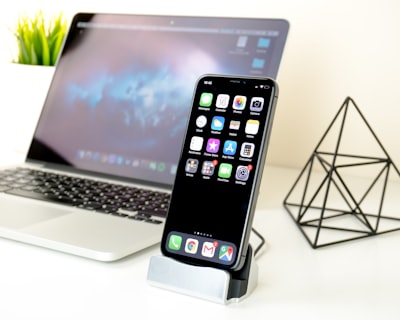
Imagine a world where the phone in your pocket can transform into a fully functional laptop without any additional hardware beyond a clever shell. A Reddit user has brought this idea to life with a 3D-printed shell that houses a Pixel 9 running GrapheneOS, turning it into a portable computer. The project, completely DIY, includes a folding keyboard, a hidden mouse, a large battery, and a shoulder strap. It has no processor of its own; the smartphone remains the brain, offering a radically different approach from traditional docks or docking stations. This innovation not only challenges the need to carry two devices but also opens the door to new ways of understanding mobility and productivity in both business and personal environments.
From a technical standpoint, using GrapheneOS on the Pixel 9 is key. GrapheneOS is an Android distribution focused on privacy and security, with kernel hardening and granular permissions. When running in desktop mode (thanks to its support for external displays and keyboards), the device can deliver an experience similar to a Chromebook or a lightweight laptop. The 3D-printed shell integrates an additional touchscreen? Actually, the project uses the Pixel's own screen as the monitor, with a design that allows closing the lid like a traditional laptop. The extra battery extends autonomy, and the folding keyboard with integrated touchpad provides adequate ergonomics for prolonged work.
The potential impact of such solutions is enormous. For companies looking to reduce hardware costs, simplify device management, or improve security, a smartphone-based model could be revolutionary. Instead of assigning a laptop and a mobile phone to each employee, a single device that docks into a lightweight shell becomes a workstation. Mobility skyrockets: users carry the same device in their pocket during the day and transform it into a laptop at the office or at home. Moreover, data centralization on the phone eliminates synchronization risks and reduces the attack surface.
However, not everything is perfect. The performance of the Pixel 9, though excellent for a phone, falls short of a mid-range or high-end x86 laptop. Tasks like video editing, code compilation, or virtualization may be limited. Connectivity also depends on the smartphone: if the battery dies or the antenna fails, the entire system stops working. Additionally, the desktop application ecosystem on Android remains immature for certain professional sectors. Still, for office tasks, browsing, email, project management, and many SaaS applications, the combination is more than sufficient.
From a business perspective, this innovation fits perfectly with the trend toward mobility and the cloud. Companies that adopt cloud AWS/Azure solutions can offer their employees virtualized environments accessible from the phone, reducing the need for powerful hardware. Security is enhanced through GrapheneOS and mobile device management (MDM) policies. The user experience can be improved by custom applications that adapt to large screens and multitasking.
At Q2BSTUDIO, a company specializing in software development and technology, we see this movement as an opportunity to rethink corporate IT infrastructure. The combination of high-security smartphones like the Pixel with GrapheneOS and smart shells could be the seed of a new category of corporate devices. To achieve this, it is essential to have cybersecurity services that protect both the device and the cloud, something we offer through our cybersecurity and pentesting services. Furthermore, artificial intelligence can play a crucial role: from AI agents that assist the user on the desktop to BI/Power BI systems that provide real-time dashboards from the phone-turned-laptop. Our AI and intelligent agents team is already working on solutions that turn any device into a proactive assistant.
The Redditor's 3D shell is just a prototype, but it proves that the convergence between mobile and laptop is viable. Major manufacturers like Samsung with DeX or Motorola with Ready For are already exploring this path, but the DIY community goes a step further by fully customizing the hardware. If this trend consolidates, we will see official shells from manufacturers themselves, with better integration, active cooling, and additional ports. Meanwhile, companies like Q2BSTUDIO can help organizations prepare for this future by developing cross-platform applications that work both in phone mode and desktop mode, and leveraging the cloud to scale resources on demand.
In summary, what started as a hobby project on Reddit raises profound questions about the definition of 'laptop' in the post-PC era. The 3D-printed shell with Pixel and GrapheneOS is not just an engineering trick; it is a statement of intent. Those of us working in the technology sector must watch these signals and adapt our strategies. At Q2BSTUDIO, we are committed to practical innovation, offering process automation and software development services that enable companies to take advantage of these new paradigms. Because sometimes, what fits in a pocket can become the most powerful work tool.
