
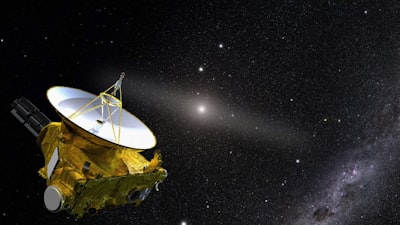
NASA's New Horizons probe has awakened after 321 days of hibernation, a technical milestone that demonstrates the efficiency of autonomous systems in long-duration missions. This event not only marks a further step in the exploration of the outer solar system but also offers valuable lessons for software development and resource management in extreme environments. From a business perspective, the ability to pause and reactivate complex systems highlights the need for custom software solutions that optimize performance and reduce operational costs.
New Horizons, launched in 2006, completed its primary mission by flying past Pluto in 2015 and later visited the Kuiper Belt object Arrokoth in 2019. After those milestones, the probe entered a hibernation mode to conserve resources while traveling toward the edges of the solar system. Now, awakened by commands sent months earlier, the spacecraft is 64.04 astronomical units (AU) from Earth, approximately 9.5 billion kilometers. For context, one AU equals 150 million kilometers, and New Horizons has traveled 23 AU beyond Arrokoth, a greater distance than that separating the Sun from Uranus (19 AU). NASA schedules these hibernations to save energy and bandwidth, as no commands are sent or data downloaded during cruising. Only when a potential target is detected or passive data collection on the solar wind and interstellar medium is needed does the probe reactivate.
This resource management approach is comparable to strategies implemented by modern tech companies. At Q2BSTUDIO, for example, we develop artificial intelligence systems and autonomous agents that can operate in low-power mode until triggered by specific events. Just as New Horizons uses passive sensors to collect data on the heliosphere, companies can deploy cybersecurity solutions that monitor networks in the background and activate alerts only for real threats, optimizing resource usage. The analogy is powerful: hibernation is not a shutdown but an intelligent standby state.
New Horizons' extended mission plans to continue collecting data on the Sun's interaction with the interstellar medium until it exits the Kuiper Belt in 2028 or 2029. If no additional object is found to visit, the probe will follow the path of the Voyagers, which have already crossed the heliopause. Voyager 1 is at 170 AU and Voyager 2 at 140 AU, while the heliopause is thought to be around 130 AU. New Horizons could become the fifth human-made object to leave the solar system, after the Voyagers and Pioneers.
From a technical standpoint, New Horizons' awakening involves verifying all subsystems: communications, propulsion, scientific instruments, and power management. NASA confirmed the probe responded correctly, demonstrating the robustness of the design. In the business world, such reliability is essential when deploying critical applications in the cloud. That is why Q2BSTUDIO offers AWS and Azure cloud services that ensure high availability and disaster recovery, similar to the hibernation and reactivation protocols of space probes.
Space exploration also benefits from artificial intelligence and autonomous agents. Onboard systems on New Horizons must make decisions without human intervention due to communication delays (hours to reach Earth). This requires predictive algorithms and machine learning models that optimize trajectory and fuel usage. At Q2BSTUDIO, we develop AI agents to automate business processes, from customer service to inventory management, applying similar principles of autonomy and efficiency.
The collection of scientific data during the cruise phase is another relevant aspect. New Horizons uses passive instruments to measure solar wind, cosmic particles, and magnetic fields. This data is stored and transmitted periodically. In the corporate world, Business Intelligence (BI) with Power BI allows companies to capture information from multiple sources, process it in the background, and generate reports only when needed, saving computational resources. Q2BSTUDIO helps implement these solutions, integrating data from AWS, Azure, and legacy systems to provide real-time visibility without saturating systems.
New Horizons' hibernation also reminds us of the importance of long-term planning. NASA designed the probe to last decades, with redundant components and updatable software. Similarly, companies that invest in custom applications and scalable architectures achieve long-term returns, as they can adapt to new needs without major cost overruns. At Q2BSTUDIO, we apply agile methodologies and modular design so that software evolves alongside the business.
Finally, New Horizons' mission is a testament to collaboration between engineering, science, and information technology. Each awakening of the probe is an opportunity to learn more about our cosmic neighborhood and to improve the systems that allow us to explore it. In the business world, integrating cybersecurity and automation is equally crucial. Q2BSTUDIO offers pentesting and data protection services to ensure that cloud infrastructures and AI applications are secure and resilient, just like the probes that challenge interstellar space.
In conclusion, New Horizons' awakening after 321 days is not just an astronomical news item but a source of inspiration for software engineering and technology management. The ability to hibernate and reactivate complex systems with precision is a model that companies can emulate by using advanced technologies such as artificial intelligence, cloud computing, and custom software development. At Q2BSTUDIO, we are committed to applying these principles to create solutions that optimize resources and maximize performance, exactly as NASA does with its interstellar probes.
