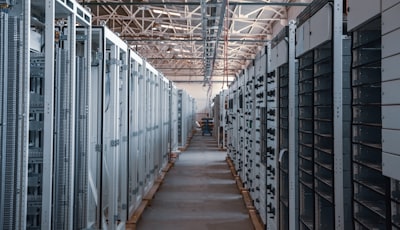
When discussing the race for artificial intelligence, most analysts and media focus on language models, algorithms, and advances in neural network training. However, investment data from recent quarters reveals a different reality: tech giants are spending nearly $700 billion annually on infrastructure, not on model development. Microsoft, Amazon, Google, and Meta have announced capital expenditure plans that far exceed what they allocate to software R&D. What is driving this paradigm shift? The answer lies in the very nature of AI scalability.
Artificial intelligence, especially generative models and large language models (LLMs), does not scale like traditional software. It scales like heavy industry. A new model can be trained in weeks, but the data center that runs it requires years of planning, permits, electrical infrastructure construction, and fiber optic networks. The competition is no longer just about having the best algorithm, but about securing the physical resources that allow those algorithms to operate at a global scale. Those who control the infrastructure will control the future of AI.
At Q2BSTUDIO, a company specialized in custom software development, we observe that many organizations underestimate the complexity of deploying AI solutions in production. Having a powerful model is not enough; a solid foundation of cloud, cybersecurity, and business intelligence is required. Therefore, in this article we analyze the strategic reasons behind the massive investment in AI infrastructure and how companies can prepare for this new scenario.
The myth of the model as competitive advantageDuring 2023, the conversation revolved around which company launched the smartest model. But by 2024, the focus shifted to GPUs: obtaining graphics processing units became the new gold. However, by 2026 the real bottleneck will not be chips, but the entire ecosystem that supports them. A GPU without electricity, cooling, network connectivity, and a prepared data center is nothing more than a silicon brick. The real competitive advantage lies in solving those problems before others do.
Big tech knows this. OpenAI, with its Stargate project, has planned a $500 million investment in infrastructure, while xAI is building one of the largest AI campuses in the world, with capacity for 555,000 NVIDIA GPUs and 2 GW of power. These are not software projects; they are industrial projects. And the key is that infrastructure cannot be bought with money overnight. It takes time: years to obtain permits, connect to the power grid, manufacture transformers, and build facilities. Capital can buy hardware, but it cannot buy time.
The bottleneck: the power grid and permitsOne of the most common mistakes is thinking that setting up a data center takes months. The reality is that, although the building can be constructed in two years, connecting to the power grid can take five to seven years. High-power transformers are ordered years in advance, and environmental and urban planning permit processes further extend timelines. Microsoft, Amazon, Google, and Meta, despite having virtually unlimited financial resources, face the same delays as any other company. The problem is not financial, it is structural.
This creates an advantage that accumulates over time: whoever builds first gains early access to compute capacity, attracts customers sooner, generates cash flow, and reinvests while competitors are still waiting for permits. The gap widens, not because of a better model, but because of building first. It is a compound advantage that is difficult to overcome.
Geopolitical and strategic implicationsAI infrastructure is becoming an asset of national sovereignty. Countries like the United States have launched the Stargate initiative with 10 GW of planned capacity; India announced over $210 billion in AI infrastructure commitments in a single week; the United Arab Emirates is building the largest AI campus outside the US with 5 GW; the European Union has allocated €20 billion to its AI Gigafactories. These are not just technology projects; they are industrial strategies reminiscent of building ports, railways, and power grids in previous centuries.
For companies, this means that access to high-performance AI will not be universal or immediate. Companies that need to deploy complex models must plan their cloud and data center strategy years in advance. At Q2BSTUDIO, we help our clients design AWS/Azure cloud architectures that optimize resource usage and ensure scalability, while integrating cybersecurity and BI/Power BI solutions to extract maximum value from data.
Beyond models: the complete ecosystemInfrastructure investment is not limited to data centers. It includes fiber optic networks, advanced cooling systems (liquid or immersion), renewable energy sources to sustain massive consumption, and orchestration platforms for AI agents. Indeed, AI agents are emerging as the next frontier: autonomous programs that execute complex tasks without human intervention, but they require reliable, low-latency compute infrastructure.
Security is also critical. A data center with thousands of GPUs is an attractive target for cyberattacks. Cybersecurity must be integrated from the design stage, protecting hardware, software, and data. At Q2BSTUDIO, we offer pentesting and cybersecurity consulting services to ensure that AI investments are shielded against threats.
What should companies do now?The window of opportunity to secure AI infrastructure is closing. Companies that do not act in the next two or three years risk falling behind, relying on limited and expensive compute capacity. The recommendation is twofold: on one hand, evaluate long-term compute needs and start negotiating agreements with cloud and data center providers; on the other, invest in AI and process automation to integrate artificial intelligence into the business gradually, leveraging available resources today.
The massive investment in infrastructure is not a passing fad. It is an unmistakable sign that AI is maturing into an industrial sector. The winners of the next decade will not be those with the smartest models, but those who have built the physical and digital foundations for those models to operate at scale. At Q2BSTUDIO, as a software and technology development company, we work with our clients to build those foundations: from custom applications to BI and cloud solutions that sustain digital transformation. Infrastructure is the new battlefield, and those who arrive first will have an advantage for the entire decade.