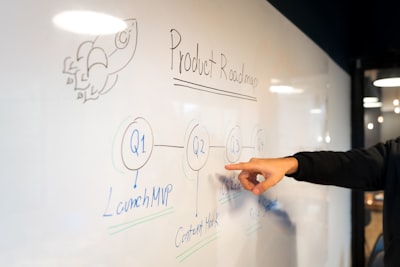
Business software solutions are the foundation on which many organizations build their competitive advantage. An innovation roadmap stops being an aspirational presentation when it is supported by applied technology: strategic goals become real features, data, and workflows. The difference between a good idea and a business outcome lies in the ability to execute, measure, and adjust continuously.
A well-designed technology platform allows business areas to avoid manual processes and information silos. Planning systems, CRM tools, ERPs, and open data environments can coexist in a coherent architecture. Moving from a pilot project to a full deployment requires an incremental approach, clear metrics, and governance that can separate experimentation from controlled risk. That is where Q2BSTUDIO adds value: it not only builds software, but also helps prioritize capabilities and connect every release to the expected impact.
One of the first challenges is choosing between standard packages and proprietary development. For very specific processes, generic features often fall short; for cross-functional needs, standard solutions speed up implementation. Custom software is especially useful when complex business rules, integrations with legacy systems, or differentiated user experience requirements exist. A well-governed custom development provides flexibility without sacrificing stability, because it is designed with maintainability, security, and evolution in mind. The choice does not have to be exclusive: many architectures combine standard and custom development to maximize speed and differentiation.
The innovation roadmap must also address infrastructure. The cloud has moved from being an option to becoming the natural environment for scaling. Technology teams need cloud AWS/Azure platforms that allow services to be deployed with elasticity, high availability, and pay-per-use models. In addition, cloud makes experimentation with emerging technologies easier: isolated environments can be created, artificial intelligence APIs can be tested, and what does not work can be discarded without large initial investments. Q2BSTUDIO has helped companies structure multi-cloud environments and define cost, security, and deployment policies from the start.
Governance of the innovation roadmap is not a brake, but a mechanism for prioritizing. Instead of approving projects by intuition, criteria such as value, cost, risk, and strategic alignment can be established. Light committees review each initiative and decide whether it continues, is adjusted, or is stopped. This discipline allows ideas to move into production in an orderly way, without blocking creativity. Companies that master this balance generate a balanced portfolio of incremental improvements and transformative bets.
Artificial intelligence is no longer a future concept. Organizations that integrate AI into their processes gain a direct advantage in efficiency and decision-making. From internal assistants that answer employee questions to predictive systems that anticipate demand, AI can be adopted progressively. AI agents represent the next evolution: programs capable of planning, executing, and learning within controlled circuits. This requires careful design of boundaries, quality data, and human oversight to avoid risks. AI does not replace strategy: it accelerates strategy when connected to real business problems.
Data is the fuel of innovation. Without a solid Business Intelligence layer, decisions continue to rely on intuition. Tools such as Power BI make it possible to consolidate scattered indicators into actionable dashboards. The goal is not to generate more reports, but to answer key questions: which products are profitable, which segments are growing, where efficiency is lost. Q2BSTUDIO implements BI solutions that connect operational and strategic sources, ensuring that teams work with a single version of the truth. Data quality, traceability, and access security are essential conditions for analysis to generate trust.
Cybersecurity must be present in every layer of the roadmap. Innovating fast cannot mean exposing critical information. A comprehensive security program includes code auditing, pentesting, access management, encryption, and continuous monitoring. If the novelty is an AI agent acting on internal systems, permissions and traceability must be defined. Companies need technology partners that understand this tension between speed and control. Security is not a barrier, but a condition for innovating with confidence and protecting the organization's reputation.
The human factor also influences the success of a roadmap. It is not enough to implement tools; people must be supported during the transition. Automating repetitive tasks frees time for higher-value activities, but requires redesigning roles and processes. Business areas need to participate in defining requirements and validating hypotheses in safe environments. An innovation roadmap is more effective when it combines technology, agile methodologies, and constant communication. Teams that understand the purpose behind change drive it more naturally.
Innovation metrics must go beyond the number of launched projects. It is useful to measure the time from idea to first prototype, user adoption, impact on costs or revenue, and the stability of new systems. These metrics should be reviewed periodically and communicated transparently. When a team knows exactly what success means, it is easier to maintain focus and stop what is not working in time. Learning from each initiative should feed the next cycle.
A good practice is to create cross-functional teams that work in short delivery cycles. These teams should have access to test environments, anonymized real data, and collaboration tools. The pace must be sustainable: each iteration generates learning, even when the result is not released to production. Q2BSTUDIO implements frameworks where software evolves together with the business model, avoiding large deliveries that arrive late and misaligned. This reduces uncertainty and increases the ability to respond to market changes.
Another key point is organizational change management. Innovating does not only mean changing tools, but also changing the way people make decisions. Training programs, internal champions, and feedback channels accelerate adoption. It is also worth celebrating learnings, both successes and controlled failures. An environment that learns from each iteration generates more confidence and attracts people who want to build the future, not just maintain the present.
In short, business software solutions and the innovation roadmap are part of the same system. Technology makes sense only if it accelerates the path toward strategic goals. To achieve this, a comprehensive vision is needed, one that combines custom development, cloud platforms, artificial intelligence, data, and security. Q2BSTUDIO is an ally on this journey, providing technical knowledge, methodology, and execution capacity.