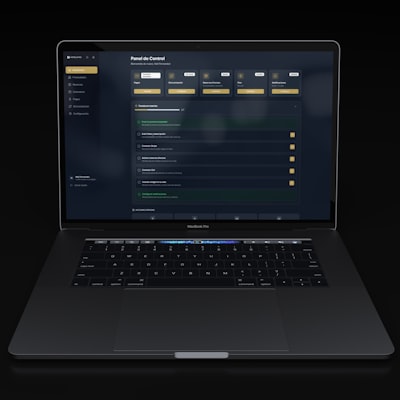
Digital transformation is no longer measured by the number of applications a company uses, but by its ability to anticipate, react and evolve. An organization that is prepared for the future is one that understands technology as part of its strategy, not as an expense. Well-designed enterprise software allows every department to share information, automates processes and gives management real visibility into what is happening.
An enterprise software strategy does not begin by choosing technologies, but by understanding workflows, friction points and business objectives. Many organizations live with systems that do not communicate, spreadsheets that duplicate data and manual processes that consume time. Digital maturity consists of replacing those gaps with a solid architecture where information flows securely and automatically.
That is why custom software development has become a key lever for building competitive advantage. It is impossible to differentiate with processes identical to everyone else's. Standard applications solve generic needs, but they do not reflect how each company works or its business rules. An application designed for a specific organization fits its methodologies, strengthens its advantages and removes bottlenecks that generic software does not perceive.
Moreover, custom software does not have to replace all existing systems. It can coexist with ERP, CRM and other tools, acting as a layer that organizes data and unifies processes. In this way, previous technology investment is not lost; it is integrated into a more coherent ecosystem.
The cloud is the natural foundation for that integration. Working with providers such as AWS and Azure allows applications to scale on demand, teams to access data from anywhere and business continuity to be protected. Cloud infrastructure is not an end state, but the support that makes it possible to deploy new capabilities quickly and reduce operational risk.
The cloud, however, also introduces new attack surfaces. Therefore, cybersecurity must be present in every layer of software: from application design to user access. Strong authentication, encryption, audits and penetration testing are necessary practices to prevent technological openness from becoming a vulnerability.
When infrastructure and security are aligned, the next step is to turn data into knowledge. A Business Intelligence and Power BI solution makes it possible to visualize KPIs, detect trends and anticipate problems before they become crises. Information is no longer scattered and becomes a usable asset for sales, operations and management.
Artificial intelligence adds a new dimension to enterprise software. AI models can analyze large volumes of data, propose corrective actions and automate repetitive decisions. It is not about replacing human judgement, but about freeing people from low-value tasks so they can focus on strategic activities.
One of the most relevant advances is AI agents. These components act inside digital processes: they resolve incidents, classify requests, generate reports or execute transactions. When an AI agent connects with internal systems, the organization gains responsiveness without increasing the burden on the human team.
Orchestrating all these elements requires an enterprise architecture approach. Software is not a collection of independent modules; it is a network of services that must work together. Process automation, for example, connects tasks between systems, applies business rules and leaves evidence of every action. This approach reduces errors and makes the organization predictable.
Agility is not improvised. It requires real-time information for decision-making and enough autonomy for teams to act. It also requires governance mechanisms that ensure regulatory compliance, data quality and access control. Technology helps centralize these policies without slowing down business speed.
The adoption of enterprise software is not only a technical project. People must understand why their tools change, how to improve their routines and what benefits they will gain. Training, communication and support are part of success. An excellent platform does not deliver results if teams do not use it with confidence.
Q2BSTUDIO supports organizations in this process from a comprehensive perspective. As a software development and technology company, it combines engineering, design and strategy to create solutions that fit each client's reality. It does not sell closed products; it builds responses based on concrete business needs.
Its services include custom application development, system integration, process automation and cloud migration. They also include the implementation of BI solutions, cybersecurity reinforcement and the deployment of AI capabilities. This combination makes it possible to tackle complex projects without losing technical coherence.
Cybersecurity is not a separate department or a final phase. It must be considered from the start of any initiative: threat modeling, data encryption, identity management and continuous testing. An organization that is prepared for the future includes security as a design condition, not as a patch.
The result of such work is a more resilient company. Resilient in the face of market changes, new regulations, security incidents and pressure to innovate. Resilience does not mean avoiding risks, but having the ability to absorb them and continue operating normally.
In short, enterprise software should stop being seen as a cost center and become an engine of evolution. Companies that invest in flexible technology, integrated data, intelligent automation and solid security are better positioned to face any scenario.
Choosing a technology partner is a strategic decision. Q2BSTUDIO brings a practical business vision and rigorous technical execution so that every software investment generates measurable value. The question is not whether an organization should transform, but how it wants to prepare for the future.