The intranet with smart onboarding has become a priority for many companies that want to reduce the time it takes new people to get up to speed and avoid leaving them stuck between scattered documents, credentials, training materials, and manual processes. A frequent technical question is whether this platform should connect directly to corporate databases or through APIs. The answer is not either/or, because the right architecture depends on the type of information, the operational risk, and the business objectives.
In real projects, a modern intranet works as an orchestration layer. It is not just a news portal; it is the place where every employee enters, searches, learns, and executes tasks with the help of AI. For that to happen, the platform needs to access HR, talent, operations, logistics, or customer data, and that access is solved with mechanisms worth understanding before making a decision. The good news is that there is no need to replace the entire current ecosystem; an integration layer can be built on top of heterogeneous systems.
Those who defend direct database connections argue that they are faster, allow complex queries, and simplify internal reporting. That is true in bounded scenarios: internal data warehouses, product catalogs, organizational master tables, historical indicators. In those cases, the intranet can read the database with a restricted user, through a private network, and deliver near real-time data without depending on an intermediate service. The risk is that a database exposes the underlying model and can suffer performance issues if the intranet runs inefficient queries.
APIs, on the other hand, provide valuable abstraction. A process-oriented API encapsulates business rules, validates permissions, logs access, and returns only the necessary information. Moreover, if the system evolves, the intranet does not notice the change because the API contract remains stable. For this reason, when dealing with SaaS applications, ERPs, CRMs, or HR platforms, the recommended route is almost always the API. API connectivity also simplifies auditing and reduces the exposure surface.
So what is the answer to the title question? It depends on the workflow and the context. If the goal is to feed a dashboard, an analytics replica, or an artificial intelligence model that needs large volumes of data, connecting the intranet to databases or a data lake makes sense. If the goal is for the employee to perform an action, for example update their profile, request equipment, or enroll in a training course, the connection should be through an API to guarantee transactional consistency and security.
Smart onboarding adds an interesting layer. It does not limit itself to showing documents; it interprets the person's role, detects training gaps, suggests tasks, recommends contacts, and activates approval flows. To achieve that, it needs to combine database reads with API calls. It can read the organizational chart and policies from the database, but when the AI agent needs to create a ticket, send an email, deploy an account, or register a training, the API is the safest channel.
The reference architecture for this kind of initiative usually starts with custom software acting as an integration core. Instead of using a generic intranet and filling it with plugins, many companies choose to build their own modular solution. In this way, they control the data model, the user experience, and the evolution of the system without depending on a closed vendor. Q2BSTUDIO develops that custom software with a practical approach: first it understands the processes, then it defines the data architecture, and finally it implements the interface and the integration.
Regarding infrastructure, there is no need to choose a single model. Q2BSTUDIO deploys intranets on cloud AWS or Azure, and also hybrid environments when the company has critical on-premises systems. The most common combination includes the intranet in the cloud, with in-memory database replicas or analytical stores for fast queries, while transactional systems stay where they are. For hybrid environments, VPN, Private Link, or service endpoints are used so that no database is open to the internet.
Cybersecurity is a factor that often influences the choice between database and API. A well-built API limits visible fields, applies role-based control, and can log every request. A direct database connection, on the contrary, invites arbitrary queries and extracting more data than needed. For an intranet with smart onboarding, which processes personal employee data, encryption in transit, delegated authentication SSO/OIDC, role-based access control, and retention policies are essential. Cybersecurity is not an isolated department: it is a design layer.
Another advantage of this hybrid architecture is that it allows the introduction of generative AI in a controlled way. The assistant integrated into the intranet can retrieve information from the database, generate summaries with RAG, and execute actions through AI agents. For example, when a person joins the company, the agent can propose their training plan, reserve the necessary resources, and generate a personalized task list. To keep those actions reliable, each agent must have limited access and human checkpoints in critical steps.
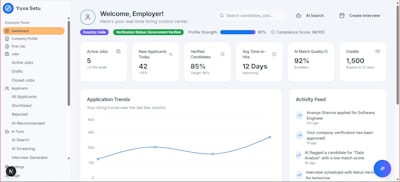
Artificial intelligence should not be hidden in an isolated experiment. If it is embedded in workflows, the effect is much greater. An intranet with smart onboarding can measure average time to productivity, number of incidents in the first month, satisfaction of the new hire, or speed of training completion. This data can be loaded into a Business Intelligence system and visualized with Power BI, so the leadership team can see progress without waiting for manual reports.
The implementation process should combine discovery, prototyping, and iteration. During the first weeks, the Q2BSTUDIO technical team works with HR, IT, and business leaders to identify which onboarding tasks will be digitized, which data can be trusted, and which integrations are priorities. Then an MVP is designed to show real value without building the entire perfect system. That test makes it possible to validate whether it is better to connect certain data by database, by API, or both.
Deciding to develop an intranet with smart onboarding is not a minor decision, but it does not have to be an enormous project. When you start with a modular base and a team experienced in custom software, AI, cybersecurity, and cloud AWS/Azure, the result is a platform that reduces manual work, improves the new employee experience, and gives executives a much clearer view of operations.
In short, there is no single answer to the question of whether an intranet with smart onboarding connects to databases or APIs. The right option is to design a hybrid architecture, governed by APIs for transactional actions and open to databases for analytical queries or AI models. Companies that get this decision right make technology work in their favor, with reliable data and automated processes. If you are evaluating this transformation, it is wise to do it with a partner that understands both the technical side and the real business impact.