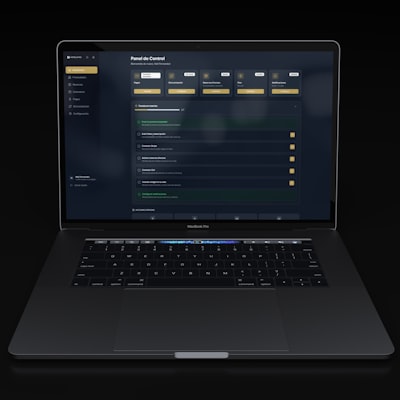
The contemporary business landscape demands efficient, agile, and secure management of every process that drives growth and competitiveness. To meet this demand, companies increasingly rely on enterprise management software, also known as ERP (Enterprise Resource Planning) systems or custom software applications. This article explores in depth what an enterprise management software does, how it integrates with daily operations, the benefits it offers, and how Q2BSTUDIO, a leader in software and technology development, can support companies in their digital transformation.
An enterprise management software is an integrated platform that centralizes information and automates key processes of an organization. Its primary goal is to eliminate data fragmentation and dependence on isolated tools such as spreadsheets or standalone CRM systems. By consolidating information in a single repository, the software facilitates data-driven decision making, reduces human errors, and speeds up responses to market changes.
Typical functionalities of an enterprise management system include:
1. Inventory and logistics management: stock control, orders, warehouses, and distribution.
2. Finance and accounting: invoicing, accounts payable and receivable, bank reconciliations, and financial statements.
3. Human resources: payroll, talent management, time tracking, and regulatory compliance.
4. Sales and marketing: opportunity tracking, campaign management, and performance analysis.
5. Production and operations: production planning, quality control, and equipment maintenance.
6. Business Intelligence (BI): interactive dashboards, real-time reports, and predictive analytics.
7. Process automation: workflows that reduce manual intervention and ensure operational consistency.
8. Artificial Intelligence (AI) and AI agents: virtual assistants, data-based recommendations, and anomaly detection.
9. Cybersecurity: protection of sensitive data, regulatory compliance, and penetration testing.
10. Cloud (AWS/Azure): scalable deployment, high availability, and secure remote access.
Integrating these functionalities not only improves operational efficiency but also creates a data culture that drives innovation. When sales, finance, and operations teams share the same data vision, response times are reduced and forecast accuracy increases.
### Advantages of enterprise management software
1. Full visibility: managers can access key metrics in real time, facilitating the identification of bottlenecks and resource optimization.
2. Error reduction: automation of repetitive tasks minimizes the risk of human failure.
3. Scalability: cloud architecture allows adding users and features without proportional costs.
4. Business agility: the ability to adapt processes and workflows to market demand.
5. Security and compliance: integrated cybersecurity modules ensure data protection and compliance with local and international regulations.
6. Competitiveness: by reducing operational costs and improving service quality, companies can differentiate themselves from competitors.
### Q2BSTUDIO’s role in digital transformation
Q2BSTUDIO positions itself as a strategic partner for organizations seeking to modernize their processes through custom software applications and automation. Our approach combines technical expertise with deep business understanding, enabling us to design systems that fit each client’s operational reality.
The collaboration process with Q2BSTUDIO includes:
1. Strategic diagnosis and consulting: we understand the company’s challenges and objectives to define a technology roadmap.
2. Design and development of custom software: we create solutions that integrate AI, BI / Power BI, and cybersecurity modules.
3. Cloud implementation: we deploy on AWS/Azure to ensure availability and scalability.
4. Training and ongoing support: we ensure teams adopt the new system and that the software evolves with business needs.
### Real-world use cases
In the manufacturing sector, an electronics component producer implemented an ERP that integrated inventory management with production planning and quality traceability. The result was a 30 % reduction in cycle times and a 15 % improvement in customer satisfaction.
In the retail sector, a store chain adopted a process automation system that optimized the supply chain and reduced logistics costs by 20 %. Additionally, the incorporation of AI agents in customer service resolved 40 % of inquiries without human intervention.
### Conclusion
Enterprise management software is not just a tool; it is the core that connects all areas of an organization, enabling coherent, secure, and data-driven operations. Adopting comprehensive solutions, especially when combined with emerging technologies like AI and cybersecurity, positions companies to face current and future market challenges.
If you want to take your business to the next level, contact Q2BSTUDIO and discover how custom software can transform your operations.