The relationships between verbal language and visual language have characterized the theoretical study of images during the 20th century.
Images are the units of representation of visual language just as words are of written language. In digital culture, the visual consumption of citizens has skyrocketed to previously unimaginable levels.
Advertising and design, artistic creation, political and social communication, have found in visual language a very powerful tool for communicating knowledge and emotions directly, or for visually supporting a specific idea.
Thus, in a world where the media have high levels of power, the control of the image and its technical manipulation has become a central element in the dissemination of knowledge at all levels. Images are not neutral, and beyond displaying the artistic and aesthetic intentions of creatives, they assume political, commercial or social functions.
The analysis of the use of visual language in the current context leads us to realize -quickly- the fusion that takes place between drawing, photography, video, text and symbol, etc. in multimedia production, where the orderly mixing of languages and resources is of vital importance, with the intention of communicating and interacting with the user.
We call multimedia the combination of various communication media with an interactive vocation in a single visual space; whether this is a screen or any digital device. The increase in the capacity of computer processors and the reduction in their cost have propelled a revolution in the implementation of digital media that, in themselves, require multimedia language to be fully exploited and guarantee a practical, rich and effective user experience.
Multimedia creation -therefore- will require the study and treatment of the different communication languages: visual, textual, sound, etc. to achieve the desired final product. Thus, the design of a multimedia environment will necessarily involve a conceptualization and design phase, a programming phase for the operation and structure of the environment, and a third phase of layout of the final appearance.
The design of multimedia products is basically oriented toward the web environment and the creation of interactive applications (software). Multimedia design is a very effective tool for transmitting a message based mainly on graphic design, which is the discipline responsible for ordering information in an aesthetic and legible way for the user, and displaying it in an attractive way. Through design we combine texts, images, colors, animations, videos, spaces, audio and interaction in a computer application.
While it is true that there are some basic design principles that are perfectly valid in the digital environment: proportion, rhythm, unity, emphasis, variety, etc., it is no less true that multimedia –the sum of different languages in the same environment and in an organic way– require a particular approach when facing a project.
Decisions about the design of a multimedia environment will be conditioned, at all times, by the technical possibilities of the platforms where we develop the application, and the programming languages necessary to make it work.
The early stages of multimedia design took place in an unstable environment in which there were no reference standards. The lack of experience in the sector caused genuine absurdities in the form of unintelligible websites or ones impossible to understand for the normal user. The appearance of very powerful visual technologies, and the little time devoted to reflecting on their introduction into the web environment, caused Flash -for example- to become an obstacle to accessing information in the form of endless presentations or navigation environments that were very difficult to use.
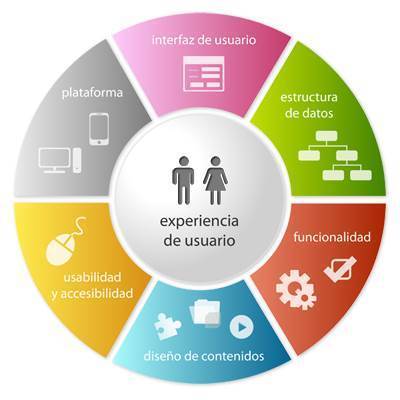
Little by little, however, designers realized the need to introduce user experience analysis to design much more intuitive and easy-to-use environments. In this context usability is born, which is the branch of design that deals with analyzing and designing the user experience in the use of an interactive multimedia environment.
Today there is a wide range of companies, professionals and researchers working in the field of user experience (UX) improvement, which has made it one of the most active and dynamic branches of the sector.
There is a language of usability: a set of rules and codes that ensure that the user experience takes place in a comfortable, functional and interactive framework. Experience is something subjective, which cannot be defined from design; even so, if we guarantee a solid, direct and simple design, we will enhance the positive user experience.

User experience
Advertising and design, artistic creation, political and social communication, have found in visual language a very powerful tool for communicating knowledge and emotions directly, or for visually supporting a specific idea.
OUR SERVICES
How we can help you
Artificial intelligence
AI agents, chatbots, and intelligent assistants that automate tasks and serve your customers 24/7 to improve the efficiency of your business.
More info →Software Development
Software development for companies in Spain: web, mobile and desktop applications, intranets, e-commerce, SaaS and custom management platforms, with accessibility and good practices included.
More info →Cloud services
Migration, infrastructure, landing zones, networks, managed databases, scalable hosting and security in Microsoft Azure and Amazon Web Services so that your business grows according to the capacity you need.
More info →Cybersecurity and pentesting
Security audits, penetration testing and protection of applications, data and infrastructure on-premise and cloud. Ethical hacking and support in regulatory compliance (ENS, ISO 27001, GDPR) without promising certification.
More info →Business Intelligence
Operational reporting and predictive analytics with Power BI and Microsoft Fabric: we integrate your sources, design dashboards and KPIs and turn your data into informed decisions.
More info →Process automation
We automate repetitive tasks and connect your applications with n8n (open-source, self-hosted), Power Automate (Microsoft 365), Make or RPA, eliminating manual work. If you need AI agents, you'll find them in our AI hub.
More info →Training for companies
We train your teams in technology with criteria: web development, databases, Git, best practices and security, automation with n8n, artificial intelligence for companies and creation of AI solutions with Microsoft Foundry (formerly Azure AI Foundry).
More info →Code Auditing
We audit the code that you, your team or an AI create: we tell you what is good and what to improve, we secure it and make it ready for production, with evidence for ENS, ISO 27001, GDPR, NIS2 and DORA.
More info →Conversational avatars with AI
We create conversational avatars with AI – digital humans with a face and voice – for B2B cases: internal training, retail, events and customer service. They are not text chatbots or multimedia content; they are visual interlocutors with the knowledge of your company.
More info →Online Marketing and AI
Paid media, technical SEO, GEO/AEO, email marketing, landing/CRO and analytics: we capture useful demand and measure results without promising positions.
More info →AI Governance, Security, and Responsible Operation
We help inventory, control, and professionalize AI applications, automations, and agents without slowing down teams' ability to innovate.
More info →On-premise local AI: hardware, models, and operation
We implement on-premise local AI to reduce token costs and keep data at home: hardware sizing (NVIDIA GB10 / AMD), LM Studio stack → vLLM and integration with real processes.
More info →


Do you have a project in mind?
Tell us your vision and we'll turn it into a software solution. Whatever the scope, we make your idea real.