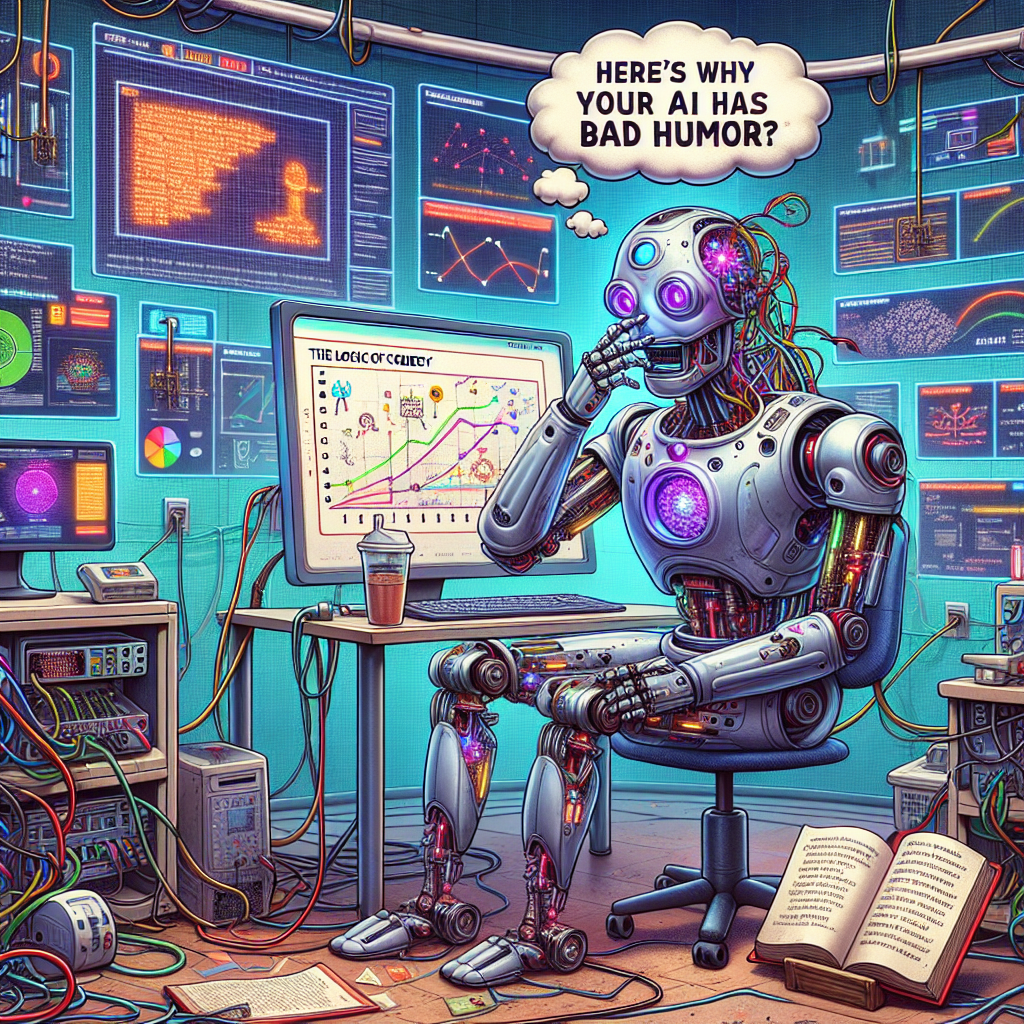
Have you ever asked an AI model to tell a joke and it responded with something terribly unfunny? Something like:
Why do programmers prefer dark mode? Because light attracts bugs!
Revolutionary. Really.
More often than we'd like, AI-generated jokes are predictable and strange. The reason? It's a machine! It has no human context, it only identifies patterns in the data it has been trained on. When we ask it for a joke, it simply strings words together based on probabilities, without understanding true wit or comedic timing.
This is no secret to those of us working in AI development, but it's interesting to know what makes it work that way. With that understanding, we could also figure out how to make AI generate better jokes.
The AI 'learns' what a joke is
An AI model, like GPT or any joke bot, is not born with a sense of humor. It learns from thousands of examples extracted from books, websites, and conversations. However, instead of understanding humor like we do, it only recognizes statistical patterns.
Here is a simplified example of how an AI model might process joke structures:
import random
setup = ['Why did the chicken cross the road?', 'What do you get when you mix an AI with a comedian?', 'Why don't programmers love nature?']
punchline = ['To get to the other side!', 'A neural network with bad timing!', 'Too many bugs.']
print(random.choice(setup) + ' ' + random.choice(punchline))
See the problem? The AI recognizes the pattern of a joke: first the setup and then the punchline, but it doesn't understand why something is funny.
The AI predicts the next words, not the funniest ones
AI models operate solely on statistical probability. Models like GPT predict the most likely words to continue a sentence. This works well for autocomplete text, but it's terrible for original humor.
For example, if the AI generates the setup: 'Why did the chicken cross the road?', it will look for the most common answer and repeat 'To get to the other side!', even if it's the least funny.
from collections import Counter

jokes_dataset = ['To get to the other side!', 'Because it was programmed to do it!', 'To escape the robots!']
probabilities = Counter(jokes_dataset)

print(probabilities.most_common(1)[0][0])
That's why AI jokes are often predictable and repetitive.
The AI lacks context and world knowledge
Humor is deeply tied to emotions, human experiences, and culture. And these are precisely the things that AI doesn't fully understand. Despite being trained on enormous volumes of data, it still struggles with:
- Sarcasm: 'Oh great, another AI-generated joke!'
- Wordplay: 'An AI walks into a bar... and fails the Turing test.'
- Social awareness: 'Why did the AI go to therapy? Because it couldn't process its emotions.'
Although it can recognize joke structures, it doesn't understand why something is funny. As a result, it sometimes tries too hard to be comedic and fails.
attempts = ['I'm hilarious, believe me!', 'Why did the AI end the relationship? It lost the spark!', 'What's an AI's favorite drink? Java.']
print(random.choice(attempts))
And who to blame? These are machines trained on large volumes of data, but we don't want them to end up sued for training on comedians' material without permission.
How to improve AI humor
If you want to get better jokes from an AI, you have to be specific. Indicate the style you prefer (like Chandler Bing's sarcastic humor or Louis CK's dark humor), provide a situation, and describe the type of humor you're looking for. It won't make its response perfect, but at least it won't be so rigid and predictable.
This gives it a frame of reference to work within. Without context or human understanding, all it can do is guess the punchline, and it usually does so in the most obvious way possible.
At Q2BSTUDIO, experts in software development and artificial intelligence, we understand the current limitations of AI and constantly work on technological solutions that optimize the capabilities of these tools. We specialize in creating software tailored to our clients' needs, helping companies enhance their processes through innovation and intelligent automation.
See you next time!