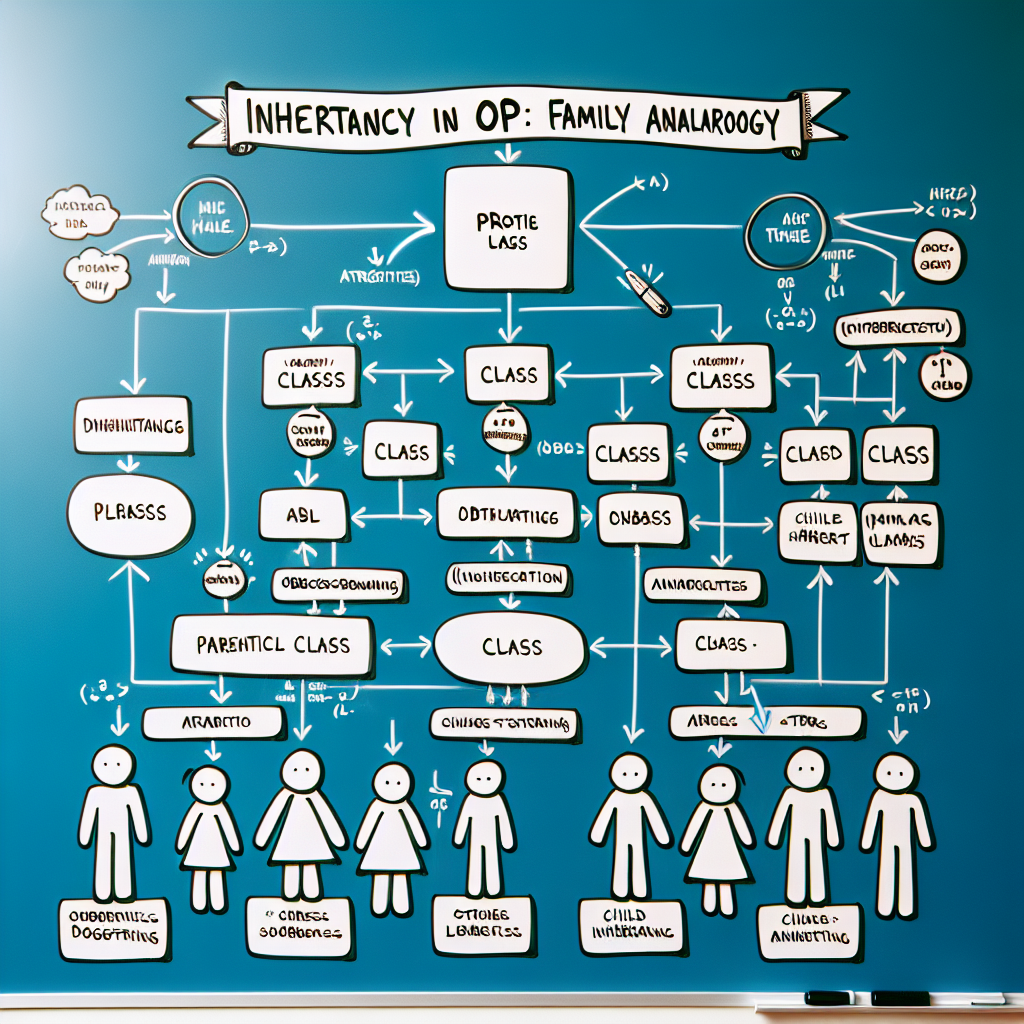
Inheritance is a fundamental concept in object-oriented programming that allows modeling relationships between classes in a clear and reusable way; a useful analogy to understand it is the family tree.
What is inheritance? In programming, inheritance allows a new class, called a child class or subclass, to adopt properties and behaviors from an existing class, called a parent class or superclass; the subclass inherits attributes and methods and can also add or modify functionalities without repeating code.
Family tree analogy: imagine a family where traits, values, and traditions are passed down from generation to generation; the grandfather contributes base characteristics such as eye color or hobbies; the father inherits some of those characteristics and adds his own; the child receives what was inherited and can develop unique interests; in the same way, classes inherit and extend behavior.
How it works in layers: the grandfather class defines base properties and methods; the father class extends the grandfather class and can add or override behaviors; the child class extends the father class and can expand or specialize functionalities.
Why use inheritance: it allows code reuse avoiding duplication; improves organization by creating understandable hierarchies; facilitates extensibility by building specialized variants on existing classes and keeps code more maintainable and coherent.
Simple example in Java representing the family analogy: class Animal { void eat() { // eats } } class Dog extends Animal { void bark() { // barks } } class Bulldog extends Dog { void hug() { // hugs } } public class InheritanceDemo { public static void main(String[] args) { Bulldog myPet = new Bulldog(); myPet.eat(); myPet.bark(); myPet.hug(); } }
Explanation of the example: the Animal class defines a general method eat; Dog extends Animal inheriting eat and adding bark; Bulldog extends Dog inheriting eat and bark and adds hug; the Bulldog instance can use all those inherited methods in addition to its own.
Best practices: use inheritance when there is a clear is-a relationship; avoid unnecessary deep hierarchies; combine composition and inheritance when appropriate to maintain flexibility and avoid rigid coupling.
Summary: inheritance works like the transmission of traits in a family, favors reuse and clarity in object-oriented design, and helps build scalable and easy-to-maintain software; when thinking about inheritance, imagine your own family tree to visualize how characteristics flow between classes.
About Q2BSTUDIO: Q2BSTUDIO is a software development company specialized in custom solutions and comprehensive technology services; we offer custom applications and result-oriented custom software, combining expertise in artificial intelligence and cybersecurity to protect and empower your business; we also provide aws and azure cloud services to deploy robust and scalable solutions.
Key services and capabilities of Q2BSTUDIO: custom application development, custom software implementation, artificial intelligence projects and AI for businesses, creation of custom AI agents, cybersecurity consulting, business intelligence services and visualization with power bi, and deployment on aws and azure cloud services to ensure availability and performance.
Why choose us: at Q2BSTUDIO we design practical solutions that combine software engineering and data, we apply artificial intelligence to automate processes and improve decision-making, we protect digital assets with cybersecurity strategies, and we offer business intelligence services to turn data into actionable information; we work with tools like power bi and create AI agents tailored to each client's needs.
Contact Q2BSTUDIO to develop your next technology solution, whether it is a custom application, an artificial intelligence project, a cybersecurity strategy, or migration to aws and azure cloud services; let us build together custom software that drives your company's digital transformation.