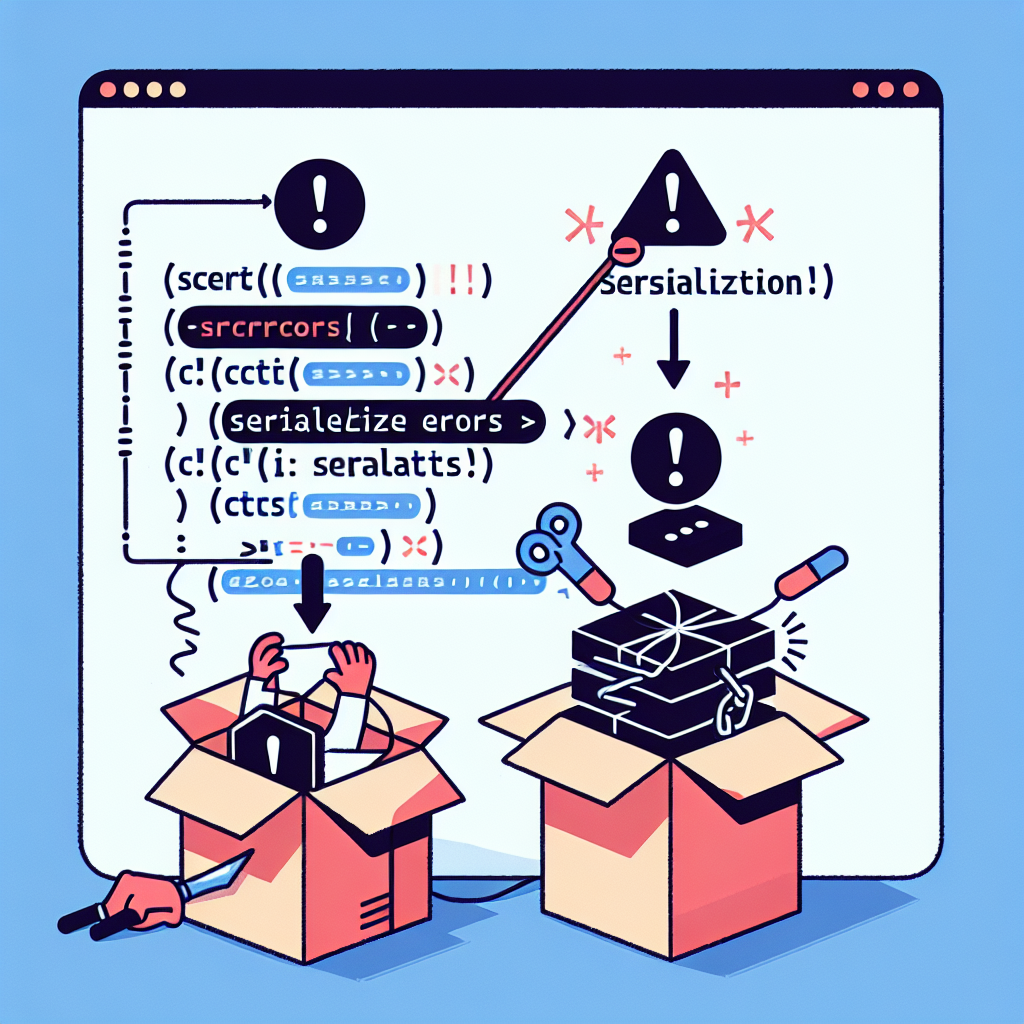
This article explains how to serialize and deserialize an error by converting it into a plain object. It describes the use of serializeError in Flyde, what Flyde is, and how the serialize-error package works, as well as providing use case examples and how Q2BSTUDIO can help integrate these practices into real projects.
Using serializeError in Flyde: in the Flyde repository, the import of serializeError from the serialize-error package appears, and its use within a function that converts values to strings for the remote debugger. The function detects the type of the value and, if it is an instance of Error, applies serializeError followed by JSON.stringify to obtain a safe representation of the error. If the object cannot be serialized, it returns an indication that it is not serializable and, when applicable, truncates the output with a length limit constant to avoid excessively long messages in the debugging interface.
Description of the toString function: the routine checks the typeof of the received value, handles the object case, and detects Error instances. For errors, relevant information such as name, message, and stack is transformed into a plain object using serializeError and serialized to JSON. For general objects, it attempts to stringify and, in case of error, catches the exception and returns a generic text indicating that the object cannot be serialized. For other primitive types, it returns their string representation truncated according to the configured limit.
What is Flyde: Flyde is an open source visual programming platform oriented to back-end logic that integrates with existing codebases. It facilitates collaboration between technical and non-technical profiles to design visual flows that execute server-side logic, allowing product managers, designers, and developers to work on the same visual representations of processes.
About the serialize-error package: this package is used to serialize and deserialize errors into plain objects, useful when it is necessary to apply JSON.stringify or send errors between processes with process.send. Its installation is done with the command npm install serialize-error. The package exports serializeError and deserializeError. In a typical flow, an Error is created, its serialized version is obtained with serializeError, and that representation can be converted back into an Error instance with deserializeError when received in another part of the application.
Example of use explained without code: create an error with new Error, pass the error to serializeError to obtain an object with fields such as name, message, and stack, send that object over the network or through a process channel, and at the receiving end apply deserializeError to reconstruct the exception and be able to handle it or log its full stack.
Advantages and use cases: serializing errors allows exceptions to be logged consistently in structured logs, sending errors to remote services for centralized analysis, debugging distributed applications, and transmitting failure information between processes or microservices. It is especially useful in remote debugging, orchestration systems, serverless environments, and when integrating AI agents that require error traceability.
Q2BSTUDIO and how we can help: Q2BSTUDIO is a software development company specialized in custom applications and custom software. We offer advanced solutions in artificial intelligence for businesses, creation of AI agents, cybersecurity services, implementation of aws and azure cloud services, and business intelligence services projects. We can integrate error serialization practices into deployment pipelines, design structured logging compatible with Power BI for analysis, and build AI agents that report exceptions safely and traceably.
Featured services of Q2BSTUDIO: custom application development, custom software for critical processes, artificial intelligence and AI solutions for businesses, custom AI agents, cybersecurity applied to applications and data, migration and deployment on aws and azure cloud services, and business intelligence services with Power BI integration for dashboards and advanced analytics.
Practical recommendations: include serialize-error in the back-end exception handling layer to ensure errors can travel between processes and services without losing context. Log the serialized object in structured logs and feed business intelligence dashboards to detect failure patterns. For integrations with AI and intelligent agents, normalize the error representation to facilitate automated diagnosis and learning about recurring incidents.
References and useful resources: link to the Flyde repository on GitHub https://github.com/flydelabs/flyde/blob/main/core/src/remote-debugger/utils.ts#L1 and the serialize-error package page on npm https://www.npmjs.com/package/serialize-error. For contact and technical consulting from Q2BSTUDIO, write to ramu.narasinga@gmail.com or visit the company's website to request project evaluations and proof of concept in artificial intelligence, cybersecurity, and cloud services.
If you want Q2BSTUDIO to help you implement error serialization in your architecture or develop custom applications with artificial intelligence integration, AI agents, and Power BI dashboards, get in touch and we will advise you on the best architecture and the choice of aws and azure cloud services that optimize security and performance.