
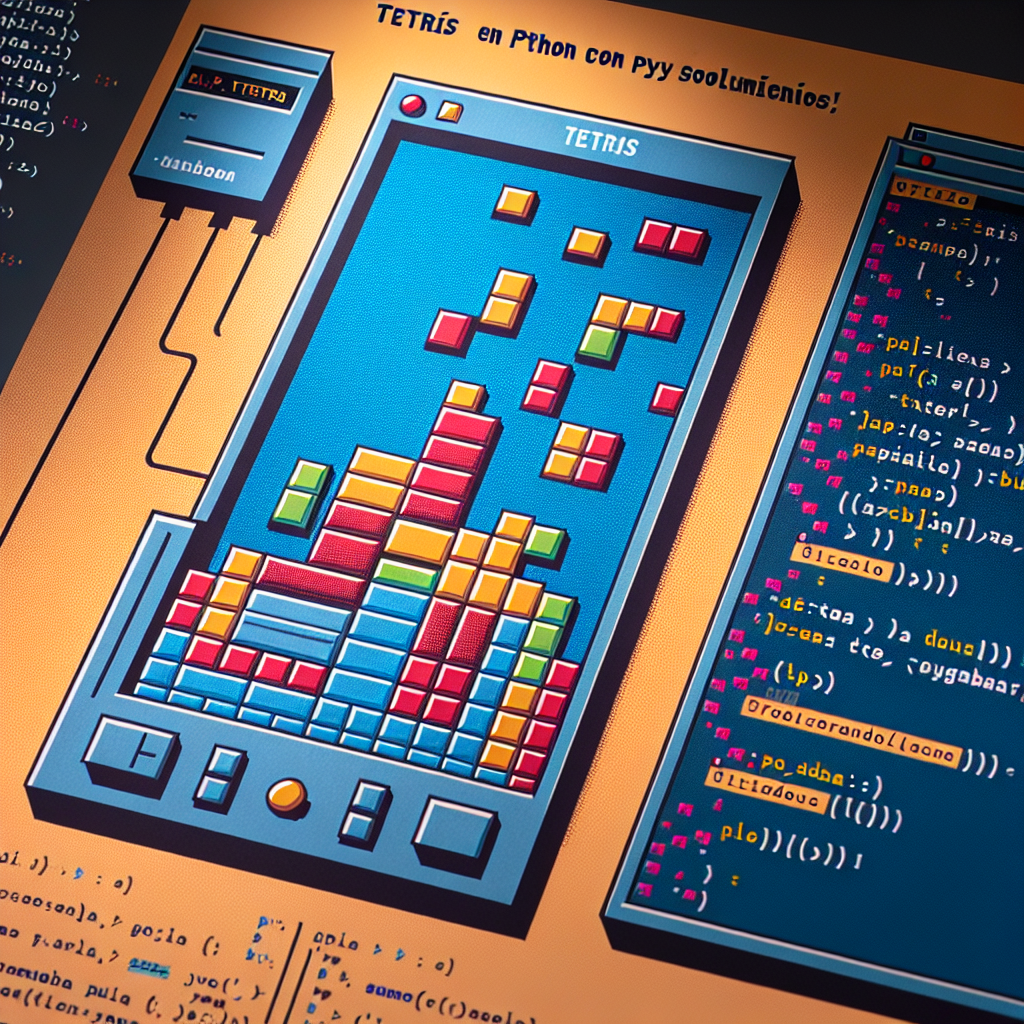
Recently I developed a version of the classic Tetris in Python and PyGame and I share below my journey, the challenges that arose, and the solutions applied.
Why choose Tetris Tetris is ideal as a project because it combines complex logic with simple mechanics, it is excellent for practicing object-oriented programming, it allows exploring software architecture, and it has a controllable scope for an individual project.
Main technologies Python 3.8+ PyGame 2.0+ MVC Architecture Clean Code Principles
Implemented features - Complete piece system with rotation - Collisions and game physics - Progressive and balanced scoring - Difficulty increase - Preview of the next piece - Intuitive controls
Technical challenges and solutions 1. Circular import issues. Problem: organizing model view controller modules without generating circular imports. Solution: I structured the project with absolute paths and a well-defined package by adding the root directory to the path at the entry point to avoid circular dependencies. 2. Piece rotation. Challenge: rotating pieces without them leaving the grid or crossing other pieces. Solution: I implemented matrix transposition and collision checking after rotation, applying offset corrections when necessary. 3. Balanced scoring system. Challenge: creating a scoring curve that rewards combos. Solution: I used a function that scales exponentially based on the number of lines completed simultaneously and adds multipliers for consecutive combos.
Project architecture I adopted the MVC pattern to separate responsibilities and facilitate maintenance. model.py contains the game logic and state. view.py handles graphical rendering. controller.py manages inputs and interaction logic. constants.py groups global configuration.
Lessons learned Code organization: the MVC architecture facilitated maintainability and testing. Python for games: PyGame is powerful but requires manually managing the game loop and resources. Game mathematics: collision and rotation logic requires solid mathematical concepts and iterative testing.
Next steps - Add initial menu and configuration options - Implement persistent highscore system - Add sound and visual effects - Create local multiplayer version and alternative modes
About Q2BSTUDIO At Q2BSTUDIO we are a software development company specialized in custom applications and custom software. We offer artificial intelligence and AI solutions for businesses, AI agent development, cybersecurity, AWS and Azure cloud services, and business intelligence services including Power BI. We work on customized projects that integrate automation, advanced analytics, and data protection for companies of all sizes.
Why work with us We combine experience in custom application development with capabilities in artificial intelligence, cybersecurity, and cloud architecture to deliver scalable and secure solutions. If you are looking for custom software, AWS and Azure cloud services, or implementing business intelligence and Power BI projects, at Q2BSTUDIO we have the experience to support you.
Project repository Source code available on GitHub: https://github.com/esthevamnascimento/Tetris_game.git
Conclusion Developing this Tetris was a very rewarding challenge that helped me grow as a developer. I recommend this project to anyone who wants to improve their skills in Python and game development, and apply good architecture and clean code practices.
Question for the community Have you ever developed a classic game or a project with Python and PyGame? Share your experience and doubts, and if you need help with custom software projects, artificial intelligence, cybersecurity, AWS and Azure cloud services, or business intelligence, contact the Q2BSTUDIO team.

