
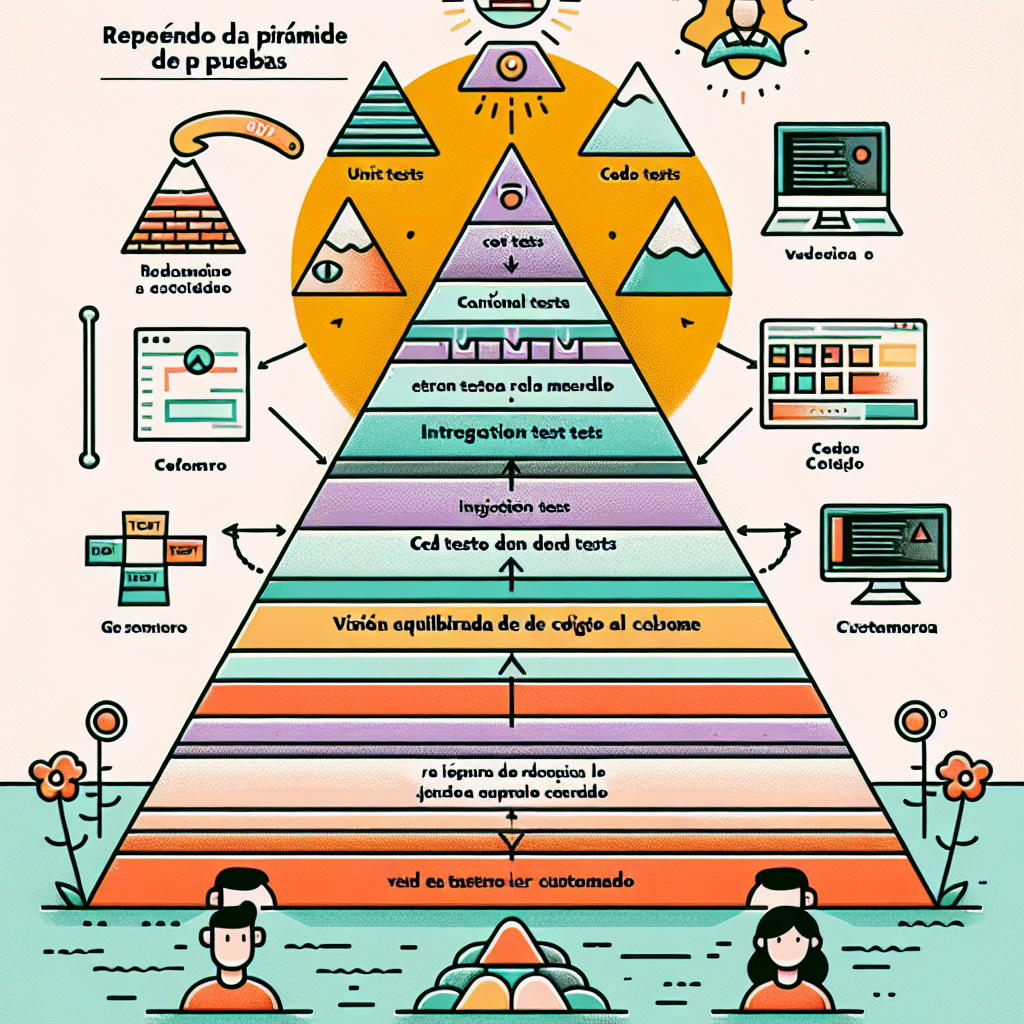
Rethinking the Test Pyramid: A balanced view from code to customer
The classic test pyramid proposed by Mike Cohn remains a useful guide for structuring tests: many fast unit tests, some integration tests, and few slow user interface or end-to-end tests. This approach prioritizes development speed and technical cost, but sometimes falls short when what really matters is the customer experience and confidence.
From a business perspective, the pyramid is inverted. High-value end-to-end tests provide the greatest confidence about whether users can complete critical flows such as registration, purchase, or submitting requests without issues. Integration tests help reduce systemic risk, and unit tests provide fast feedback to developers, but none of them alone validates the complete user experience.
It is important to clarify that end-to-end tests do not only mean clicks on the interface. Modern E2E tests are hybrid by design. They should create data via API to set up the scenario, interact with the UI to simulate real flows, verify backend changes through database or API checks, perform efficient cleanup, and validate business rules, not just visual elements.
Practical example of a smarter E2E for a purchase: precondition via API to create user and catalog; UI flow with Playwright or Selenium for login and checkout; assertions that include on-screen confirmation, order persisted in the database, and correct status in the API; and teardown that deletes or resets data via API. This way the test remains end-to-end but is faster, more reliable, and value-focused.
There is no need to choose between the classic pyramid and the inverted view, but rather to overlay them. For fast development feedback, use unit and service tests. For protection against regressions, use integration tests and smoke tests. For business and customer confidence, prioritize high-value E2E tests that simulate real flows.
At Q2BSTUDIO we apply this balanced view in our custom application and custom software projects. We design testing strategies that combine unit testing, integration, and hybrid E2E to ensure functional quality and user experience. As specialists in artificial intelligence and cybersecurity, we integrate automated controls that validate both business logic and security in real environments.
Our services include custom application development, custom software solutions, artificial intelligence implementation and AI for businesses, secure deployments on AWS and Azure cloud services, business intelligence and Power BI services, AI agent creation, and cybersecurity consulting. All aimed at reducing risks and maximizing value for the end customer.
Some practical principles: prioritize tests that validate critical user flows; use APIs to prepare and clean data; combine UI, API, and database validations; automate smoke tests for fast CI feedback; and maintain a small set of high-impact E2E tests that provide business confidence.
Conclusion. The test pyramid remains relevant for scaling and maintaining engineering speed, but that view must be complemented with a customer-centric perspective. Only then can it be demonstrated that the system truly works where it matters. At Q2BSTUDIO we transform that strategy into concrete results using hybrid testing, artificial intelligence, cybersecurity, and cloud services to deliver custom applications and custom software solutions that generate measurable impact.

