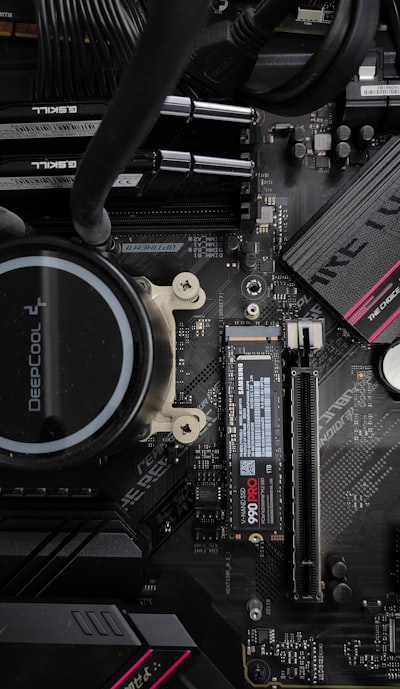
The launch of the Samsung 990 SSD has generated a mixture of expectations and doubts in the storage market. In a context where artificial intelligence is monopolizing the production of NAND memory, this new model arrives with the promise of being a step forward compared to its predecessor, the 990 EVO, but without reaching the performance of the 990 EVO Plus. Is it really the AI's fault that this SSD isn't great? Let's discuss the technical details and business impact.
The Samsung 990 uses an internal controller and memory that, although Samsung does not openly confirm, behaves like QLC (Quad-Level Cell). This translates to a good read speed of up to 7.1 GB/s, but sustained write drops dramatically when the secondary cache is depleted, reaching a mere 200 MB/s. On the other hand, models such as the 990 EVO Plus, with TLC memory, maintain more than 1 GB/s even after filling the cache. For the average user, who rarely writes hundreds of gigabytes in a row, this difference may go unnoticed, but for data-intensive applications or on-premises servers, it's a critical factor.
The launch price of the Samsung 990 is another controversial point: it rivals that of the Pro range, being more expensive than alternatives from lesser-known brands. Samsung justifies this strategy by the shortage of NAND memory, caused in large part by the demand of data centers for artificial intelligence. Factories are prioritizing the production of high-density chips for servers, leaving less capacity for consumer units. This phenomenon directly affects companies that need to upgrade their storage infrastructure.
In the corporate world, the choice between a next-generation SSD and a more balanced one depends on the intended use. For everyday tasks such as office automation or navigation, the Samsung 990 is sufficient. But if the company requires massive data transfers, real-time databases or multimedia file processing, it is advisable to opt for TLC or even PCIe 5.0 models. This is where the need for a technology partner that understands these complexities comes into play. For example, Q2BSTUDIO offers artificial intelligence services for companies that allow you to optimize data management, predict bottlenecks and choose the most appropriate hardware solutions.
Artificial intelligence is not only transforming the semiconductor market, but it is also changing the way companies manage their information. AI agents can monitor storage performance in real-time, while tools like Power BI help visualize usage patterns and make informed decisions. In fact, business intelligence services are becoming essential to align IT infrastructure with strategic objectives.
In addition, cybersecurity is a factor that cannot be ignored when evaluating an SSD. A disk with poor write performance can delay patching or backup, leading to vulnerabilities. Companies that handle sensitive data must ensure that their storage supports secure workloads. Q2BSTUDIO, as a software development company, integrates cybersecurity practices into its projects and offers AWS and Azure cloud services that ensure high availability and data protection.
In the field of application development, storage is a key component. A custom software that handles large volumes of data requires an SSD with low latency and consistent writes. That's why, when designing solutions, Q2BSTUDIO engineers evaluate recommended hardware and deliver tailored applications that fit the capabilities of the available storage. In addition, AI-powered process automation for business can minimize the impact of SSD limitations by streamlining workflows.
Going back to the Samsung 990, its three-year warranty and 400 TBW per TB are acceptable for home use, but businesses typically require greater durability. In write-intensive contexts (such as on file servers or databases), an SSD with TLC memory and a five-year warranty is more secure. The final decision will depend on the balance between price, performance and real need.
The phenomenon of AI causing NAND scarcity is real. Chipmakers are redirecting their production toward the needs of data centers, where margins are higher. This has caused consumer SSDs, such as the Samsung 990, to use QLC memory to reduce costs, although at the cost of write performance. The question is whether the end user should accept this compensation or whether, on the contrary, they should wait for the market situation to stabilize.
For companies that cannot wait, the recommendation is to evaluate alternatives such as the 990 EVO Plus (if it is still available) or models from other manufacturers. It's also crucial to have a hybrid storage system that combines fast SSDs for hot data and slower disks for cold files. Q2BSTUDIO helps design these architectures, integrating AWS and Azure cloud services to scale on demand.
In conclusion, the Samsung 990 is not a bad SSD, but it is not excellent. It represents a trade-off between cost and performance in a market distorted by artificial intelligence. Companies looking to maximize their technology investment should analyze their specific needs and rely on experts like Q2BSTUDIO, which offers everything from custom applications to cybersecurity solutions and business intelligence services with Power BI. So, while AI is to blame for the current situation, it can also be the solution to manage it intelligently.