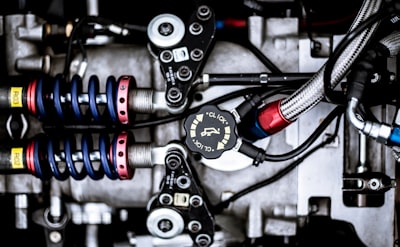
In the modern automotive industry, precise control of hydraulic systems is a critical challenge, especially in components such as clutches, where pressure must be precisely modulated to ensure smooth transitions and energy efficiency. A paradigmatic case is the hydraulic clutch control circuit that integrates a variable force solenoid valve, an accumulator, a pressure regulating valve and a shut-off valve (latch). This system exhibits highly nonlinear behaviors due to the hysteresis of the materials, the abrupt transitions of the latch and the dynamics of the actuators. Traditionally, models based on physical principles (such as those implemented in tools such as Amesim) have been the norm, but their accuracy is limited when faced with real operating conditions, where hysteresis and latch regimes escape simplified equations.
Faced with this reality, a data-driven approach has become relevant: combining classification techniques to identify the operating modes of the latch with Gaussian regression (GP) models to predict the response pressure. The central idea is that, by extending the input vector with information derived from the current (e.g., its temporal variation), and then segmenting the operating space into regions where the latch behaves distinctly, local GP models can be trained that more faithfully capture hysteresis and nonlinearities. In recent studies, classifiers such as the nonlinear support vector machine (SVC) and gradient boosting have demonstrated the highest accuracies in the separation of these regimes, with SVC being the one chosen for a robust local regression pipe. The results validated with unseen ramp data show that the machine learning model replicates the measured pressure and hysteresis more accurately than the physical simulation, opening the door to a new generation of plant models for hardware development and controller calibration.
This advance is not exclusive to the field of hydraulic engineering. It represents a broader trend in the industry: the need to complement physical models with artificial intelligence techniques that learn directly from test data. When representative testbeds are available, approaches like this allow you to reduce prototyping iterations and speed up the commissioning of complex systems. However, implementing such a solution requires not only machine learning skills, but also a bespoke software infrastructure that integrates data acquisition, preprocessing, classification, and regression into automated pipelines. This is where specialist companies like Q2BSTudio bring real value. For example, Q2BSTudio offers artificial intelligence solutions for companies that allow the development of advanced predictive models, from conceptualization to deployment in production environments.
The practical application of this modelling is not limited to the automotive industry. Sectors such as industrial machinery, robotics or even aeronautics are faced with hydraulic systems with similar characteristics. In all of them, the ability to classify operating regimes (such as latch) and fit non-parametric models such as Gaussian processes can make the difference between reactive and predictive control. In addition, the incorporation of AI agents that continuously monitor the performance of the model and retrain with new data opens the door to adaptive systems capable of compensating for mechanical wear or changes in environmental conditions. Q2BSTudio, with its expertise in custom applications, can implement such modular architectures, connecting sensors, historical databases, and real-time inference platforms.
From a technical perspective, the typical workflow involves several steps. First, the collection of experimental data of the hydraulic circuit under different current ramps. Second, the extraction of relevant characteristics (current, current derivative, previous pressure, etc.) and the labeling of the areas where the latch closes or opens. Third, training a classifier (e.g., nonlinear SVC with RBF kernel) to predict whether the sample belongs to the open or closed latch regime. Fourth, for each regime, an independent Gaussian regression model is trained, which provides not only the estimated pressure but also a measure of uncertainty, crucial for robust control decisions. Finally, the models are validated with never-before-seen data and compared with physical simulations. In the aforementioned study, the ML-based approach outperformed the Amesim model in accuracy, especially in hysteresis zones, where the physical model tended to average behaviors.
The integration of this type of solution with AWS and Azure cloud services is natural. Intensive training processes can be scaled in the cloud, and trained models can be deployed as microservices accessible from anywhere in the plant. Q2BSTudio offers AWS and Azure cloud services that facilitate everything from secure data storage to machine learning pipeline orchestration, ensuring high availability and low latency. In addition, cybersecurity is a critical aspect when handling sensitive manufacturing data or when models directly control actuators; therefore, Q2BSTudio includes security audits and pentesting in its offer to protect the systems deployed.
Another relevant dimension is business intelligence: predictive models generate a large amount of information that, if properly visualized, can facilitate strategic decision-making. For example, pressure predictions and confidence intervals can be integrated into Power BI dashboards for engineers to monitor clutch status in real-time, anticipate failures, and optimize maintenance schedules. Q2BSTudio, with its business intelligence services, helps connect machine learning models with interactive dashboards that transform complex data into actionable insights.
Looking to the future, the evolution of these models points towards the use of autonomous AI agents that not only classify regimes and predict pressure, but also propose adjustments to closed-loop control parameters. These agents could learn from accumulated experience and adapt to changes in the system without human intervention, drastically reducing calibration times. For this vision to become a reality, bespoke software development is required that integrates control logic, continuous learning, and operational safety. Q2BSTudio has the technical capacity to build such platforms from scratch, combining cutting-edge technologies such as large language models (LLMs) to process technical documentation, or deep reinforcement to optimize control policies.
In conclusion, clutch pressure modeling using latch classification and Gaussian regression is not just a point technical solution, but a paradigm that demonstrates how data can outperform physical models when it comes to capturing complex behaviors. The combination of supervised classification and non-parametric regression, along with the right cloud and business intelligence infrastructure, offers a powerful tool for the industry. Companies like Q2BSTudio, with their focus on custom applications, artificial intelligence and cloud services, are perfectly positioned to accompany organizations in this transformation, turning experimental data into real competitive advantages.