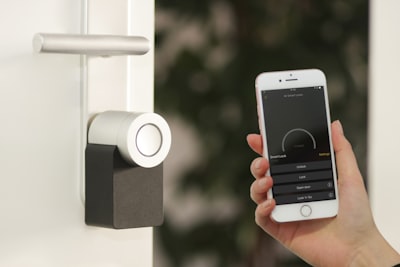
When talking about smart locks, facial recognition used to be viewed with skepticism: do they really work? Are they safe? Are they worth it? However, the latest models available on the market have turned the general perception upside down. Facial recognition locks are here to stay, and the amazing thing is that they work really well. Technology has matured enough to offer a smooth, fast and, above all, reliable experience. No more remembering codes, searching for an app or having your hands free: just approach the door and it opens automatically.
This qualitative leap is no coincidence. Behind every camera and sensor are years of advancements in artificial intelligence, computer vision, and edge processing. And while hardware is important, the real differentiating value lies in the software that governs it. For this reason, more and more specialized technology companies are offering AI solutions for companies that integrate these systems with home automation, access control or even data analytics platforms. In this article, we explore why face locks have exceeded expectations, what technical challenges they overcome, and how the combination of bespoke software, cybersecurity, and cloud services can transform home and business security.
The main attraction of facial recognition locks is the total elimination of friction. Previous solutions, such as geofence or Bluetooth unlocking, required carrying the phone with you, having the app active, and waiting for the connection to be established. They often failed or were slow. Facial recognition, on the other hand, works independently: the camera captures the face, the local processor (often with an artificial intelligence chip) compares it with the database of authorized users and, in less than a second, the door opens. No need for a network, no reliance on mobile, no delays.
Of course, the technology isn't perfect, but manufacturers have been polishing the bugs. Current models use infrared cameras and 3D sensors to prevent a photo or video from fooling the system. In addition, many incorporate machine learning algorithms that improve recognition over time, adapting to changes in the face such as beard, makeup, or glasses. This level of accuracy is only possible through the development of bespoke applications that optimize hardware performance and ensure continuous updating of AI models.
From a security standpoint, privacy concerns are logical. Storing biometric data on a device connected to the internet is always a concern. However, the most advanced locks process the images locally, without sending them to the cloud, or encrypt them before any transmission. This is where cybersecurity comes into play: a company that implements these systems in a corporate environment must ensure that facial data is protected from attacks, and that the cloud services that support the platform (such as AWS and Azure cloud services) meet the highest compliance standards. The combination of end-to-end encryption, multi-factor authentication, and continuous auditing is essential to making facial recognition a secure, not just convenient, option.
Another aspect that has surprised analysts is the integration with intelligent ecosystems. Face locks are no longer islands; They can connect with voice assistants, alarm systems, surveillance cameras, and home automation platforms. This interoperability requires bespoke software development work that adapts each manufacturer's APIs to the user's workflows. For example, a company can configure that when it recognizes an employee's face, the alarm system is deactivated, the lights turn on, and the entry is recorded on a control panel. All this is possible thanks to the implementation of AI agents that orchestrate actions autonomously.
Beyond the home, facial recognition in locks has enormous potential in the business environment. Offices, coworking spaces, hotels or logistics centres can benefit from contactless, fast access control with full traceability. Each entry is recorded, and the data can be analyzed with business intelligence tools. A custom software can integrate these records with an HR or billing system, allowing, for example, to know which employees have been late or how many times a meeting room has been used. With business intelligence services such as power BI, managers can visualize usage patterns, make decisions about spaces and optimize security.
However, not everything is positive. The cost of these locks is still higher than traditional locks, and installation may require technical knowledge. In addition, dependence on electricity means that they must have backup batteries and redundant connectivity. For a company, the initial investment pays for itself with risk reduction and operational efficiency; But for a home user, it may not be a priority yet. This is where technology development companies, such as Q2BSTUDIO, offer added value: by analyzing the real needs of the customer, designing hybrid solutions that combine facial recognition with other authentication methods (PIN, card, app) and guaranteeing scalability through AWS and Azure cloud services.
The reliability of facial recognition is also highly dependent on environmental conditions. Variable lighting, shadows, angles, or the presence of masks can affect performance. That's why the most robust systems use multiple sensors and models trained on large diverse data sets. The training of these models is a field where artificial intelligence for companies plays a crucial role. A company that wants to implement this technology in a personalized way can turn to machine learning experts who develop a specific model for its environment, improving the success rate and reducing false positives. Q2BSTUDIO, for example, offers AI services for companies ranging from consulting to the implementation of complete solutions, including the integration of AI agents that manage the lifecycle of biometric data.
Another relevant point is the user experience. The first versions of these locks suffered from notable delays or "false rejections" that forced the attempt to be repeated. Today, response times are virtually instantaneous, and manufacturers have improved liveness detection algorithms to prevent fraud. The key is edge computing, which performs inference directly on the device without relying on the cloud. Not only does this speed up the response, but it also reinforces privacy, as biometric data never leaves the home. From a business perspective, deploying this type of logic across multiple locations requires careful orchestration, often managed by bespoke applications that synchronize on-premises databases with the cloud only when needed.
The acceptance of facial recognition in locks is also driven by the familiarity users have with the technology on their mobile phones. The same experience of unlocking the smartphone with your face is now transferred to the door of the house. However, the expectations are higher: a mobile failure can be solved with a pattern, but staying away from home due to a system error is much more frustrating. That's why developers have placed special emphasis on backup mechanisms. Many locks include a physical emergency key, a numeric keypad, or the ability to unlock via an app. Redundancy is key, and designing that redundancy in a way that doesn't compromise security is a challenge that only a team with cybersecurity expertise can address correctly.
For businesses that want to adopt this technology on a large scale, managing multiple users and configuring permissions becomes a challenge. Who can enter at what times? Is access allowed to temporary visitors? How do you revoke a terminated employee's access? These questions are answered through personalized administration panels, which in turn are fed with real-time data. This is where process automation comes in, combined with business intelligence services. A well-designed system can automatically alert to unauthorized access attempts, generate compliance reports, and sync with HR systems. Q2BSTUDIO has developed solutions of this type by integrating Power BI to visualize access metrics, and using AI agents to detect anomalies in input patterns.
The surprise that smart locks with facial recognition are really good is not the result of chance. It is the result of years of R+D in machine vision, hardware miniaturization, and software optimization. Each component plays a role: from the camera lens to the deep learning algorithm that compares facial features. And at the center of it all, the integration software: the layer that connects the device to the rest of the user's digital ecosystem. That's why, when a company or an individual decides to bet on this technology, having a technology partner that offers custom application development and AI for companies makes the difference between a mediocre experience and a truly transformative one.
In short, facial recognition in locks has passed the experimental phase and is presented as a mature, secure and convenient option. The key is to choose a reliable product and, above all, to customize the solution to fit the specific needs of each user. Whether it's for the home or for an organization with hundreds of employees, combining quality hardware with tailored software that manages data, ensures cybersecurity, and leverages artificial intelligence is the winning formula. Companies like Q2BSTUDIO are at the forefront in this field, helping their clients to deploy these solutions with guarantees, from initial consulting to the implementation of cloud services and business analytics. Undoubtedly, the initial surprise turns into conviction: the future of keyless access is already here, and it works.