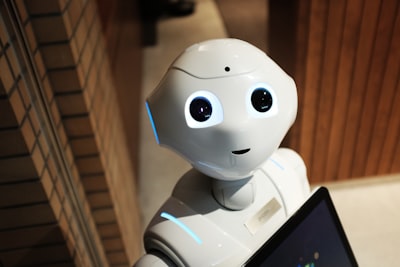
Human-robot interaction is evolving towards increasingly complex scenarios, where the ability to anticipate conversational behaviour becomes a critical factor. In particular, mediator robots designed to facilitate communication between people must understand when an interlocutor is about to take the floor, without relying solely on obvious pauses. This challenge, known as turn-taking prediction, has traditionally been addressed from audio analysis, but the limitations of this approach have driven the search for multimodal solutions that also integrate visual information. In this article we explore the Multimodal Voice Activity Projection (MM-VAP) framework, a methodology that combines audio and video signals to anticipate future vocal activity, and analyse its technical and business implications from the perspective of a software development company like Q2BSTUDIO.
The MM-VAP concept extends the original audio-only Voice Activity Projection (VAP) formulation by incorporating synchronised audiovisual inputs. This allows the robot not only to listen, but also to observe facial movements, gestures and posture changes that precede a verbal intervention. The proposed architecture uses audiovisual backbones pre-trained on speech recognition tasks, adapting them via Low-Rank Adaptation (LoRA) to the specific domain of turn-taking. Once speakers are independently encoded, an inter-speaker attention stage models the relational dynamics needed to project future voice activity. In addition, a semantic consistency loss is introduced that regularises the 256-state output space according to high-level dialogue activity patterns. Experiments on the NoXi and NoXi+J datasets show improvements over baselines, especially for turn-change events. Additional validation on the Haru EDR corpus confirms the suitability of this approach for mediation-oriented human-robot interaction.
From a technical perspective, developing multimodal turn-taking prediction systems involves significant challenges. Precise synchronisation of audio and video streams, handling multiple speakers in noisy environments, and the need for lightweight models for real-time execution are just some of the considerations. This is where companies like Q2BSTUDIO add value. With experience in custom applications, Q2BSTUDIO can design and implement software solutions that integrate these advanced models into real robotic platforms. The ability to customise every component, from data capture to inference, allows performance to be optimised for specific use cases, such as mediation in virtual meetings or assistance in educational environments.
Artificial intelligence is the main engine of this technology. Deep learning models, especially those based on transformers and attention, are essential to extract relevant features from multimodal data. Q2BSTUDIO, as a company specialised in AI, offers development and integration services for artificial intelligence solutions, including intelligent agents capable of interacting naturally with users. These AI agents can leverage voice activity projection to decide when to intervene, improving conversation fluency and reducing interruptions.
Cybersecurity is another fundamental pillar. Robotic systems that process audiovisual data must guarantee the privacy and integrity of information. Q2BSTUDIO provides cybersecurity services that protect both data in transit and deployed models, preventing unauthorised access and ensuring regulatory compliance.
Furthermore, cloud infrastructure is key for training and deploying these models. AWS and Azure cloud platforms offer scalability and elasticity, allowing large volumes of multimodal data to be processed. Q2BSTUDIO offers cloud AWS/Azure services to implement data pipelines, distributed training and inference servers, ensuring high availability and low cost.
In the analytics domain, Business Intelligence (BI) solutions such as Power BI can be integrated to visualise model performance metrics, such as turn prediction accuracy or response latency. Q2BSTUDIO provides BI/Power BI services, enabling organisations to monitor and optimise their robotic systems in real time.
Process automation also benefits from this technology. Mediator robots can automate moderation tasks in meetings, forums or classrooms, freeing up time for human participants. Q2BSTUDIO develops automation solutions that combine robotics with artificial intelligence to optimise workflows.
Implementing an MM-VAP system requires careful collection and annotation of multimodal data, as well as fine-tuning of pre-trained models. Software development companies like Q2BSTUDIO can offer consulting services to design the data architecture, select appropriate augmentation techniques, and evaluate performance under real conditions. In addition, integration with commercial robotic platforms (such as Pepper or Nao) or video conferencing systems can be carried out through custom application programming interfaces.
Looking ahead, multimodal voice activity projection could expand to multilingual and multicultural scenarios, where gestures and pauses vary significantly. Advanced AI agents, combined with reinforcement learning techniques, could learn optimal intervention policies in real time. Q2BSTUDIO is ready to tackle these challenges, offering a complete ecosystem of services ranging from custom application development to cloud infrastructure management and cyber protection.
In conclusion, multimodal voice activity projection represents a significant advance in human-robot interaction, and its successful implementation requires a combination of expertise in artificial intelligence, cloud, cybersecurity, BI and custom software development. Companies like Q2BSTUDIO are prepared to face these challenges, offering comprehensive solutions that span from research to production deployment. Collaboration between social robotics experts and software developers is key to creating robots that not only respond, but anticipate and facilitate human communication.