
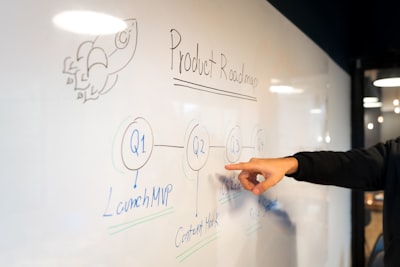
The digitization of your company is not an isolated project: it is part of how an organization learns, adapts and competes. When manual processes become digital flows, the company not only gains efficiency, but also builds a base of data and capabilities that feed its innovation roadmap. That is the difference between digitizing for the sake of digitizing and doing it with strategic intent.
In technical terms, digitization involves connecting people, systems and devices. Every automated process generates a record, and every record is an opportunity to better understand what is happening in the business. An innovation roadmap needs that visibility in order to prioritize correctly. Therefore, before selecting a technology, it is worth analyzing the process, identifying bottlenecks and deciding which data will be captured. Technology is the tool, but the operating model is always the starting point.
Standard solutions can cover generic needs, but in practice companies that achieve differentiation need software that fits their way of working. This is where custom software makes sense. A custom development allows you to incorporate specific business rules, integrate with legacy systems and evolve at the pace of strategy. Q2BSTUDIO works exactly at this point: it turns business requirements into a technical solution that not only solves the current problem, but also leaves room for the next innovation cycle.
The infrastructure supporting this solution is also critical. Moving to the cloud is not simply a hosting change: it is a decision that affects scalability, latency, security and cost. Adopting an AWS/Azure cloud strategy allows innovation teams to experiment with elastic resources, deploy versions in minutes and scale only when a product proves its value. But a misconfigured cloud can create serious risks. Cybersecurity must be integrated into the architecture from the start: access control, encryption, monitoring and incident response. To make the most of this layer, it is worth relying on AWS/Azure cloud services with clear business criteria.
Innovation is not only technical; it is also cultural. Teams need an environment that allows them to test ideas quickly, without fear of breaking the production system. That is why well-planned digitization includes controlled experimentation spaces. These isolated environments make it possible to validate hypotheses with real or simulated data before integrating a change into production. By reducing the cost of error, the organization dares to explore more options and keeps a more alive innovation portfolio.
When the digital base is consolidated, artificial intelligence adds a layer of sophistication. Data that previously served to generate reports can feed models that predict demand, detect anomalies or classify operations. The most interesting evolution is AI agents: systems that not only process information, but also make decisions within defined limits. Integrating AI agents into operational processes makes it possible to automate complex tasks that until now required human intervention, always with supervision and control of the result.
For all this infrastructure to make sense, the company needs to measure its impact. This is where Business Intelligence comes in. Tools such as Power BI make it possible to consolidate business indicators into interactive dashboards, combining data from sales, operations, marketing and technology. Thanks to this integrated view, innovation leaders can know which initiatives are generating value, which ones should be adjusted and where to allocate resources next. In this way, digitization becomes a driver of continuous improvement.
Q2BSTUDIO understands digitization as a living process. Its development team does not deliver a project and disappear; it supports the company in defining a roadmap in which technology evolves with the business. From software development to the integration of cloud services, including cybersecurity, AI or BI, the idea is that every piece is aligned with the innovation strategy. Thus, digitization is not the destination, but the lane through which new ideas travel.
A common mistake is to think that innovation requires big projects from the beginning. The reality is that the most advanced companies start with a concrete process: digitizing the approvals cycle, connecting a CRM with an ERP, or automating report generation. Once the first flow works, the organization learns, gains confidence and expands the scope. This incremental approach reduces risk and allows return to be demonstrated at each phase.
In short, digitization fits into the innovation roadmap when it is designed to learn and evolve. It is not about choosing the most modern tool, but about building a technological base that allows experimentation, measurement and scaling. Q2BSTUDIO provides that technical and business vision, helping companies take solid steps without losing focus on results. Innovation demands speed, but also a solid base; digitization offers exactly that.
Governance also plays an essential role. An innovation committee needs to define who can approve experiments, what criteria are used to move from a trial to a full deployment, and how data privacy is guaranteed. Establishing these rules does not slow down creativity; on the contrary, it gives it a safe framework. Collaboration between technical profiles, business areas and top management is what turns an idea into a real capability.
In addition, process automation is one of the most direct levers to free up team time. When repetitive tasks are delegated to software, people can focus on analysis, strategy and customer relationships. This reinvestment of talent has a direct effect on the company's innovative capacity. Technology does not replace people, but it frees them from the burden that prevents thinking.

